

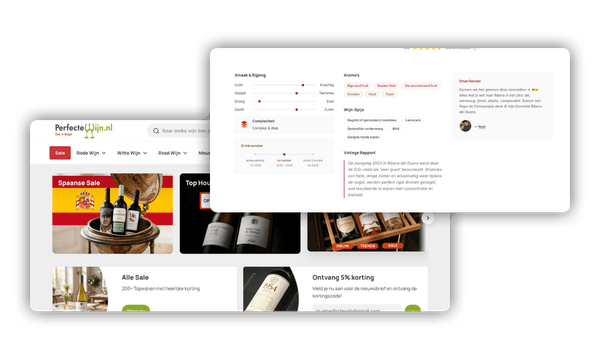
5,000+ wines in the catalog. And for every single bottle, visitors arrive with the exact same question:
“What does it actually taste like?”
For the wine enthusiast, it’s a quick verification: does the profile match their cellar and stylistic preference? For someone simply looking for an enjoyable red for Saturday dinner with friends, it’s the defining barrier between hesitating and clicking purchase: knowing what you’re getting without needing a sommelier certification.
Yet as an e-commerce director managing thousands of SKUs, you hit a stubborn operational ceiling: manually tasting and writing descriptions bottle by bottle simply does not scale.
Here is how we solved this at PerfecteWijn.nl using an autonomous AI data enrichment pipeline — and why this is fundamentally different from “just asking ChatGPT to write nice product copy”.
The Data Chaos Behind Wine E-Commerce
Anyone who thinks wine producers and importers provide clean, structured API feeds with neat attribute tags has clearly never opened a technical spec sheet from Burgundy or Piedmont.
The operational reality of wine catalog onboarding is a messy mosaic of:
- Scans and PDF tasting sheets written in French, Italian, Spanish, or German.
- Subjective, poetic tasting notes (“whispers of damp forest floor on an autumn morning” — wonderful for literature, completely useless for structured faceted search or product comparison sliders).
- Fragmented professional scores (James Suckling, Robert Parker, Decanter, Vivino) that vary drastically from vintage to vintage.
- Shifting vintage reports where one harvest produces sharp acidity from a cool summer, while the next yields dense tannins from prolonged drought.
Traditionally, enriching a single new wine required 30 to 90 minutes of manual research, translation, data entry, and tagging. With dozens of new vintages arriving weekly, this creates an enormous operational bottleneck.
The consequence: incomplete Product Detail Pages (PDPs), missing faceted filters, and hesitant buyers who bounce.
The Architecture: AI as an Autonomous Data Engine
Instead of manual copywriting, we designed an automated ingestion pipeline that transforms unstructured documents and web data into structured, mathematically comparable e-commerce metadata.
The pipeline pulls from four layered information tiers:
┌─────────────────────────────────────────────────────────────┐
│                 MULTI-TIERED DATA INGESTION                 │
├─────────────────────────────────────────────────────────────┤
│ 1. Primary Producer Data (Winery tech sheets & specs)       │
│ 2. Appellation & Varietal Benchmarks (Body & acid baselines)│
│ 3. Professional Review Aggregations (Parker, Suckling, etc.)│
│ 4. Vintage & Climate Context Reports                        │
└──────────────────────────────┬──────────────────────────────┘
                               │
                               ▼
┌─────────────────────────────────────────────────────────────┐
│            AI NORMALIZATION & VERIFICATION ENGINE           │
│  - Extraction of hard facts (oak aging, alcohol %, terroir) │
│  - Mathematical translation of subjective notes to 1-5 scale│
│  - Consistency validation against regional baseline norms   │
└──────────────────────────────┬──────────────────────────────┘
                               │
                               ▼
┌─────────────────────────────────────────────────────────────┐
│             OUTPUT ON THE PRODUCT PAGE (PDP)                │
│  ✓ Taste profile sliders (Body, Tannins, Acidity, Sweetness)│
│  ✓ Clustered aroma families (Red fruit, Spices, Oak/Toast)  │
│  ✓ Food pairing pairings ("Great with grilled lamb chops")  │
│  ✓ Ideal serving temperature & peak drinking window         │
└─────────────────────────────────────────────────────────────┘
1. Primary producer data as the ground truth
When a new wine enters the catalog, the system parses the producer’s technical sheet. Fermented in oak barriques or stainless steel? Soil composition? Maceration duration? These represent verified physical facts.
2. Regional and varietal baselines
When a winemaker’s documentation is sparse, the model relies on strict appellation and grape standards as constraints. A Nebbiolo from Barolo inherently carries a higher tannin and acid structure than a Primitivo from Manduria. This deterministic grounding prevents the model from hallucinating or assigning illogical slider values.
3. Professional reviews as fallback validation
If primary producer notes are unavailable, the algorithm aggregates verified notes from professional tasters and sommelier databases to extract a consensus sensory profile.
4. Vintage context
A 2021 Bordeaux demands different nuances than a sun-baked 2018. Factoring in vintage reports ensures the resulting profile reflects the exact year printed on the label.
From Poetic Adjectives to a Mathematical Matrix
The most critical engineering challenge in this pipeline is data normalization.
If ten winemakers describe their wine, one writes “crisp”, another “mineral freshness”, and a third “vibrant citrus acidity”. To a consumer comparing two bottles on a web shop, these fragmented synonyms cause friction.
Our pipeline normalizes thousands of descriptive variations into an objective 5-point matrix:
- Body: Light, refreshing drinkability vs. full-bodied, concentrated weight.
- Tannins: Soft and velvety vs. bold and structured with grip.
- Acidity: Crisp and refreshing vs. round and gentle.
- Oak/Aging: Pure primary fruit vs. clear vanilla, toast, and cedar notes.
Furthermore, culinary pairings are automatically assigned based on flavor intensity (a dense Amarone isn’t paired with delicate white fish, but with braised beef), alongside the ideal serving temperature.
The Testing Process: A Full Catalog Backfill
You don’t deploy an autonomous system blindly across 5,000 live products.
Months ago, we started with a comprehensive historical backfill of our entire catalog, supported by an extensive human-in-the-loop validation process:
- We spot-checked hundreds of generated profiles against our internal wine specialists’ knowledge.
- Wherever discrepancies occurred (such as outdated vintage data or conflicting sulfite notes), we tightened prompt constraints and verification logic.
- Only after the accuracy consistently exceeded 99% did the pipeline move to full automated production.
Today, this process runs completely autonomously for 99.9% of all wines in our catalog.
When a pallet of new arrivals reaches our warehouse, taste profiles, aroma families, and food pairings go live on the storefront within seconds of catalog registration.
The Commercial Impact
What does this mean for the business? In e-commerce, AI should never be a gimmick; it must directly serve contribution margins and conversion metrics:
- Eliminating purchase hesitation: Wine is an uncertainty-driven purchase. By clarifying flavor instantly at a glance, cognitive load disappears.
- Higher PDP conversion: Visitors landing from Google on a specific bottle immediately see whether it matches their dinner plans.
- Fewer mismatched purchases & higher retention: Customers who receive a bottle matching their taste expectations reorder with far higher frequency.
- Entity SEO & AI Search visibility: Structured data around grape varietals, taste attributes, and food pairings provides Google and AI answer engines (Perplexity, ChatGPT Search) rich contextual signals for indexing.
How Do You Tackle This in Your Organization?
Maintaining accurate, enriched product data at scale is a hurdle nearly every multi-SKU retailer faces — whether selling wine, hardware, consumer electronics, or fashion.
I’d love to hear how other e-commerce and engineering leaders approach this:
👉 Join the conversation on LinkedIn and share how you utilize AI and automated data pipelines in your operations!