

Over the course of your career you’re bound to experience a bunch of these: styles of leadership.
You maybe have experienced various ones, you may have pushed yourself to use a certain one, you might blend a bunch together now.
My style?
A blend of some for sure:↳ Servant for sure,↳ Democratic when situation allows,↳ Laissez-faire to some individuals (some talents flourish with minimal interference)
How did I get there?
I experienced different ones:
- I had a very autocratic, and dare I say narcissistic manager once. That showed me how it could turn a full team against their “leader”;
- I had ones that just asked what roadblocks they needed to clear for me.
Over time you pick up the things you like, the things you’ve seen bringing out the best in times, add your own self and adapt a bit to each individual.
It’s an organically grown recipe.
It defines a big part of the culture
Your style as a leader defines the work culture for a very large part, the productivity, the levels of innovation, and the relationships that grow with and within your team.
It’s not a one-size-fits-all approach, as a team still is created from a bunch of individuals who all get motivated by different things, have different (maturity) levels, different focus zones, etc.
It’s good to have a style, but to not have it be the exact same to each team member. It still comes down to ways of communicating and interacting, which is never a one-way street.
The big directions
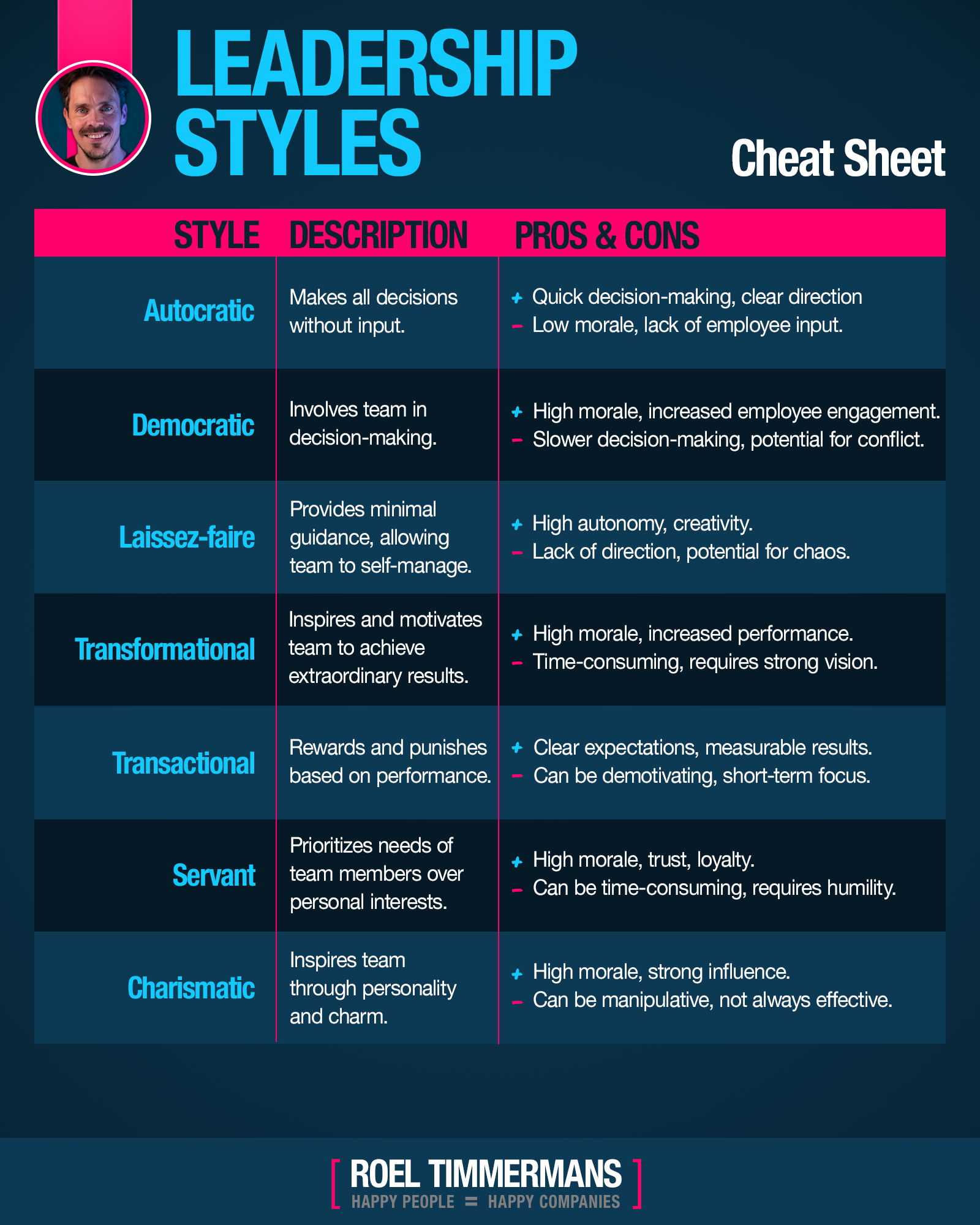
Overall you could say there’s a lot of common ground in leadership styles and therefor you could narrow it down to some flavours. Let’s explore 7 of these leadership styles and break down some pros and cons of each.
1. Autocratic Leadership
This style is mostly characterised by control and decision-making concentrated in the hands of the ‘boss’ (let’s not use leader in this case).
Autocratic bosses don’t seek input from their team; instead, they make all decisions independently.
- Pros: Autocratic leaders shine in situations that require quick decision-making and where clear direction is paramount. In high-stress environments or during a crisis, having one decisive leader can lead to fast, consistent action.
- Cons: There’s a potential for low morale. When employees are consistently left out of the decision-making process, they may feel undervalued, leading to disengagement. Moreover, without input from the team, leaders may miss out on innovative ideas that could elevate performance.
Personal Insight: In my experience, autocratic leadership can work when the situation demands quick decisions and action. Like a crisis or warzone. In most situations however this is not the style you want to resort to.
When you do it’s gonna be crucial to balance it with moments where your team feels heard. Otherwise you’re gonna create a big distance between yourself and them.
2. Democratic Leadership
Democratic leaders actively involve their team in decision-making. They gather input, encourage collaboration, and value the perspectives of their team before making final decisions.
- Pros: This style often results in high morale and employee engagement. Team members feel that their opinions matter, and as a result, they are more likely to be committed to their work and contribute meaningfully.
- Cons: This style can slow down decision-making. With multiple inputs and perspectives to consider, reaching consensus can be time-consuming, and in some cases, it may even lead to conflicts or very bland and ineffective outcomes.
Personal Insight: I think democratic leadership can work wonders in sparking creativity and bringing team unity. It’s important though to set deadlines for decisions, so processes don’t drag on forever. As well as making sure you don’t create a situation that becomes a try-to-please-all-solution.
When you try to please everyone, you really please no one.
3. Laissez-Faire Leadership
In a laissez-faire approach, leaders provide minimal guidance, allowing the team to self-manage. This style places a significant amount of trust in employees to deliver without direct oversight.
- Pros: High autonomy and creativity are the hallmarks of this style. It allows highly skilled and self-motivated employees the freedom to excel and innovate.
- Cons: The major pitfall of laissez-faire leadership is the lack of direction, which can lead to chaos, misalignment, and inefficiency. When leaders take a hands-off approach without clear guidelines, team members may struggle to know what’s expected.
Personal Insight: I had a person on my team that was just a naturally driven and talented individual, to such an extent that just creating free space for him really brought out the best. I learned is that autonomy is gold, when clear boundaries and objectives upfront is are agreed upon.
4. Transformational Leadership
Transformational leaders inspire and motivate their teams to achieve extraordinary results by creating a vision and driving change. They focus on personal and professional development, pushing their employees to new heights.
- Pros: This leadership style is ideal for teams that need a morale boost or are striving for high levels of performance. It fosters a positive and energetic environment where everyone is working toward the same vision.
- Cons: Transformational leadership is time-consuming and requires the leader to have a strong, clear vision. It can be challenging to sustain the energy and inspiration needed to constantly drive results.
Personal Insight: When you’ve got the right people (that are receptive to this) around you, transformational leadership can feel magical. You can burn out doing this. Not just you, but the team can start feeling that as well. A vision and dream are gonna be hard to believe if tangibility stays away.
5. Transactional Leadership
Transactional leadership is built around the idea of reward and punishment (the stick and carrot). Leaders set clear expectations, and employees are rewarded for either meeting them or face consequences for falling short.
- Pros: This style is excellent for delivering measurable results and establishing clear expectations. Employees know exactly what they need to do, and the transactional nature provides (extrinsic) motivation for meeting goals.
- Cons: The downside is that it can feel cold and impersonal. When used excessively, transactional leadership can lead to a lack of intrinsic motivation and create a rigid, uninspiring, and in bad cases a fear-driven work environment.
Personal Insight: Transactional leadership has its place, particularly in environments where consistency and performance metrics are key. Too much focus on rewards and punishments strips away the human element of leadership, so personally I don’t think this should be the bigger part of your style.
6. Servant Leadership
Servant leaders prioritize the needs of their team members over their own personal interests. The goal is to empower, support, and develop the team, fostering an environment of trust and collaboration.
- Pros: Servant leadership is fantastic for building high morale, trust, and loyalty. Employees feel valued and supported, leading to strong team cohesion and personal growth. It can also spark their cooperation levels.
- Cons: This style can be time-consuming and may require significant humility and patience from the leader. If not balanced well, it can also lead to the leader’s own needs being neglected. You have to learn to say “no” to a lot of things as well here.
Personal Insight: I’ve seen the impact of this firsthand, I’ve seen how a team can excel when they feel their leader is their bulldozer (clearing issues, roadblocks, etc). When employees know their leader has their back, they’re gonna be willing to go the extra mile. The challenge is ensuring that, as a leader, you don’t forget to take care of yourself in the process.
7. Charismatic Leadership
Charismatic leaders inspire their teams through their personality, energy, and charm. Their influence is derived from their ability to connect with people on an emotional level and motivate them to follow their lead.
- Pros: Charismatic leadership can significantly boost morale and encourage strong dedication to a shared cause or goal. These leaders often have a magnetic presence that draws people in.
- Cons: Charisma alone isn’t always enough, at least not in the long run. If not backed by substance, charismatic leadership can feel manipulative or lack long-term effectiveness. It can also create a dependency on the leader’s presence, leaving the team struggling or slacking when the leader isn’t around.
Personal Insight: It’s awesome to see truly charismatic leaders for their ability to rally people around them, but it’s important to pair this style with strong principles and a clear vision. Personally I think this also comes down to being your authentic self and providing clarity and trust mostly.
Conclusion
Pretty much all of these, and the ones I missed, have their time and place. I think the most effective leaders are those who found their recipe of leadership and know when to balance the ingredients to the situation at hand or person in front of them. Without losing that authenticity.
At the end of the day, leadership is about communication, connection, trust, shared goals and growth — both for the leader and their team.
