The question
Zivvy lets families see beforehand how a life decision affects their net disposable income. Working fewer hours, switching jobs, or adding childcare days.
I wanted to make a film about the moment before that choice. Around the kitchen table, late in the evening, when the calculator app is already open.
Three requirements:
- the entire life journey, from family planning to kids in secondary school
- zero financial advice, because Zivvy never tells you what to do
- never promise anything the product cannot calculate today
That last requirement turned out to be the hardest.
One sentence
The concept distilled into a single sentence that almost every family eventually utters:
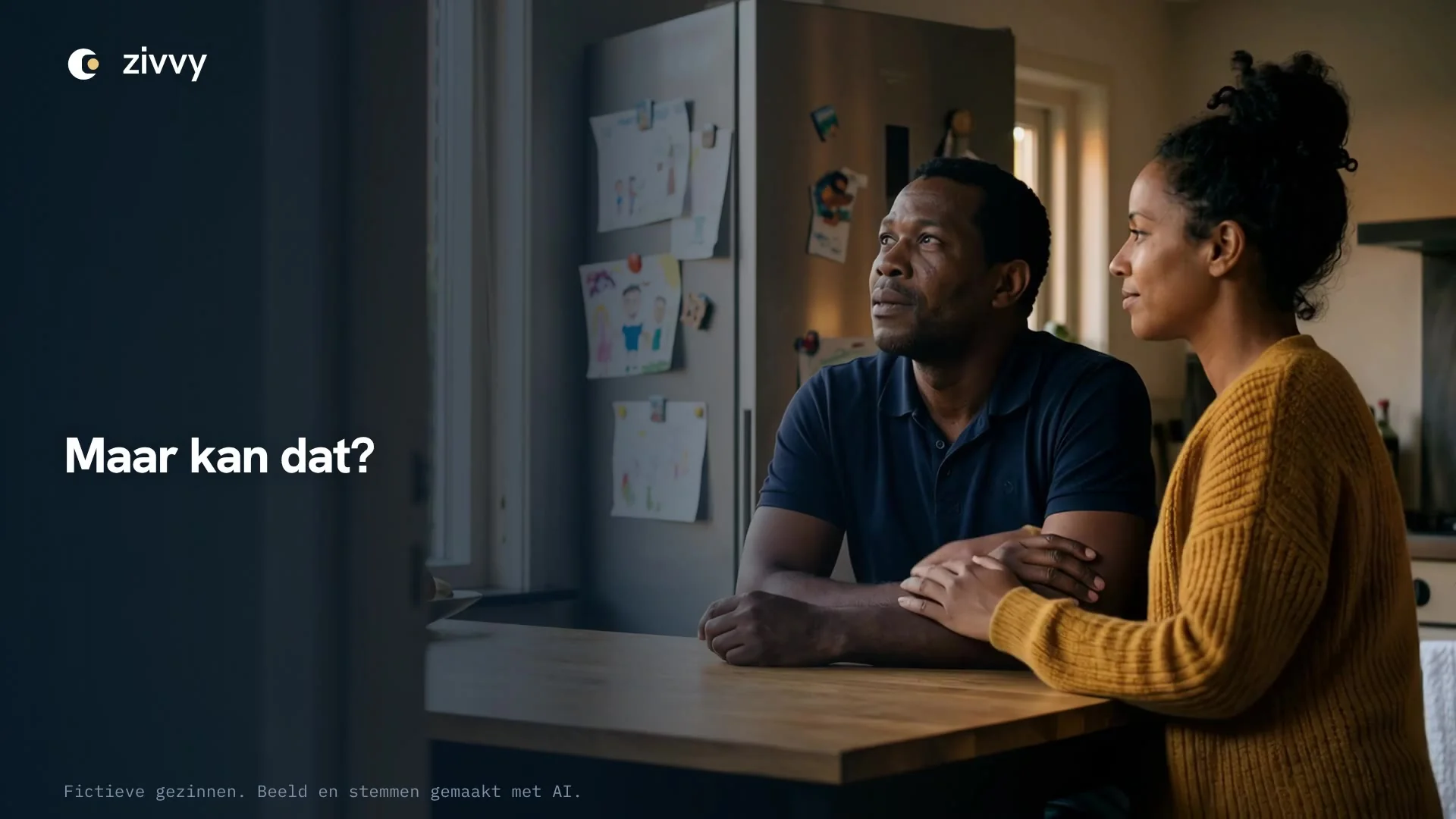
With our [ … ] we want to [ … ]. But is that possible?
The first slot represents where you stand. The second represents the choice. The tiles flip like an old railway departure board, and each time they stop, you see another family.
At the very end, the slots clear out, leaving a blinking cursor. Your situation, your choice.
The sentence functions beyond the video: as a homepage hero, as micro-videos per life milestone, and as posters at daycare facilities. A single modular device, infinitely configurable.

The team
I build this using an AI workflow that functions like a unified team. Every stage has an explicit responsibility, and all agents read and write to the same shared directory. Guidelines, architectural decisions, and checklists are documented, so nobody starts from scratch.
More importantly: every stage has the authority to object.
- script and brand narrative
- an SEO check: is this informative insight or illegal advice, are claims verifiable, what do users actually search for
- a PM check: evaluating every scenario in the script against the production code
- production using Runway for visuals, ElevenLabs for voiceovers, and our custom motion generator for typography and the closing scene
- a final verification, after which I publish manually
I personally approve the narrative, voices, faces, and aesthetic direction. The rest runs autonomously.

What was cut
Version 2 looked great. Six families, covering every step of the journey. “With our family planning, we want to buy a larger house.” “With our blended families, we want to move in together.”
Then the PM check reported back.
Moving to a bigger home: the engine does not support that yet. Cohabitation: not yet. Expecting a child as an isolated scenario: not yet.
Four of the six scenarios were inaccurate.
So we instituted one strict rule. The first slot can be any life milestone, because that simply describes reality. But the second slot must strictly represent calculations a user can perform today.
“With our family planning, I want to work one day less.” That is supported.
The other scenarios are not discarded. They remain queued, waiting until product capabilities go live.
The SEO check caught subtle phrasing. “We knew what we were getting into” sounded like certainty. Because Zivvy operates on projections and assumptions, we amended it to: “We saw upfront what would change.”

Real people, honestly labeled
I wanted human faces, because emotion lives there. Those faces were also generated with AI. That means full disclosure from the very first frame: “Fictional families. Imagery and voices generated with AI.”
A few hard principles we followed:
- nobody speaks on camera, because synthetic lip-sync immediately breaks suspension of disbelief
- one approved portrait per character as an anchor reference, keeping faces consistent across angles
- everyday people in ordinary homes, reflecting genuine demographic reality
- children shown only blurred or from behind
The outcome
A 54-second brand film delivered in 16:9, 4:5, and 9:16, a 15-second cutdown, and a narrative device we can build on for years.
What I learned
Creating fast is the easy part.
The real craft lies in asking the question most teams avoid: is this actually true?
A brand film that promises more than your product can deliver is the fastest way to destroy user trust. Let your team challenge you. Even when that team is powered by AI.
How would you complete the sentence?