

[caption id=“” align=“alignnone” width=“1024”]
AI generated multicultural workplace illustration, generated with You.com
Ok, don’t forget EQ, that is still crucial to building a positive workplace culture. But this is about the importance of Cultural Intelligence in Workplaces
Today’s world is a big mixture of backgrounds, heritages, beliefs, upbringings, etc. We need to understand each other to get along. Cultural Intelligence (CQ) helps you to not get lost in translation. It’s not just a nice thing to have, it’s needed!
I spent more than a decade in big corporate culture with people from all over the world. It showed me how being open to different views, cultures, backgrounds really makes you a richer person, and the company a lot better.
CQ means understanding and working well with people from different places. This skill helps you lead teams with people from all around the world. It also helps you do business with people from other countries. Plus, it makes everyone feel included at work.
What is CQ?
CQ is more than just knowing about other cultures. It’s a skill that helps you:
- Understand your own culture: You’ll see how it shapes your thoughts, actions, and the way you talk.
- Feel what others feel: This is called Cultural Empathy. It helps you connect with your team.
- Talk in a way that everyone understands: Clear communication is key to avoid confusion.
- Understand cultural differences: How people make decisions or lead can be different in other cultures.
- Solve problems in a multicultural team: Finding solutions that everyone agrees with can lead to better results.
How CQ Helps Managers
- Better Team Leadership: Managers with CQ can build a happy and productive team.
- Better Business Deals: CQ can help in smooth talks with international clients and partners.
- Smarter Decisions: Managers with CQ make decisions that take everyone’s thoughts into account.
- Attract Good Employees: A workplace with CQ looks good to people from all over the world.
How to Improve Your CQ
There are things you can do yourself to improve this. CQ doesn’t have to be something you were equipped with from the day you were born. Would be weird since culture is something we need to absorb, and add to over time.
Photo by Grooveland Designs on Unsplash
- Know Yourself: Think about your culture and how it shapes your views. I’m Dutch myself, so out directness (or call it being blunt) really is something I needed to be aware of.
- Learn, Learn, Learn: Try to learn about different cultures. You could read books or go to workshops.
- Listen Well: Pay attention to what others say and how they say it. And listen to how they perceive what you are saying.
- Be Humble: Be open to learning and avoid thinking your culture is the best. This is not a battle.
- Get Different Views: Include team members from different backgrounds in decision making.
- **Bring Snacks: **There’s a very low barrier way to open up the conversation, bring snacks. It always comes with a background story, occassion use cases, etc.
Cultural Dimensions
Understanding other cultures can seem like a tricky puzzle. But, there’s very useful material out there we can use. It’s called Hofstede’s cultural dimensions.
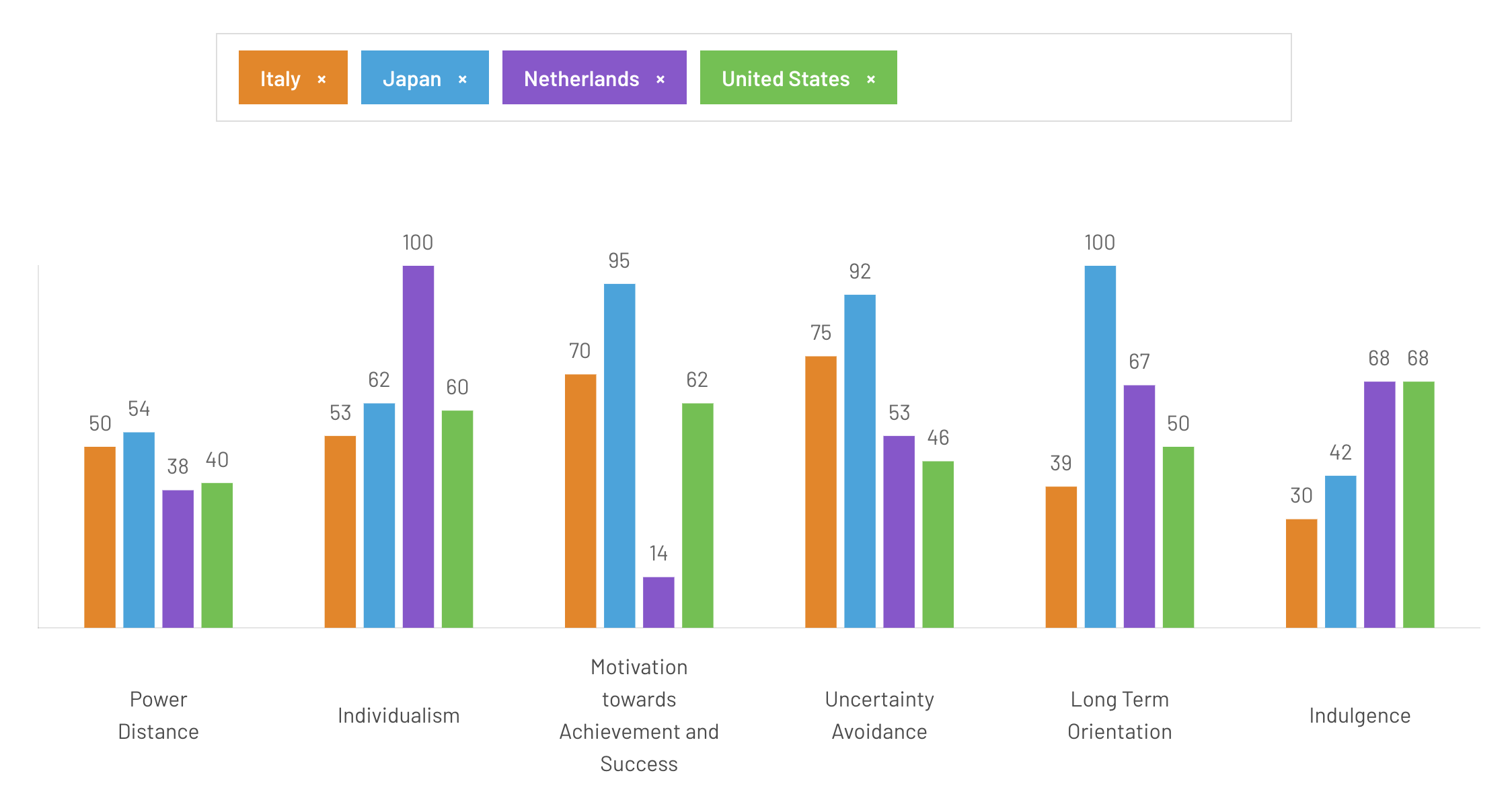Example comparison in dimensions. Source: www.hofstede-insights.com/country-comparison-tool
A fellow Dutchie, named Geert Hofstede came up with this idea. He studied people from all around the world. He found that cultures can be different in six key ways. These are the six dimensions:
- Power Distance: This is about how people feel about inequality. In some cultures, it’s okay for some people to have more power. In others, everyone should be equal. More on Power Distance
- Individualism vs Collectivism: This is about whether people think more about themselves or the group. In individualistic cultures, people are expected to look after themselves. In collectivist cultures, the group looks after everyone.More on Individualism vs Collectivism
- Masculinity vs Femininity: This is about what a culture values. Masculine cultures value things like success and competition. Feminine cultures value things like quality of life and caring for others.More on Masculinity vs Femininity
- **Uncertainty Avoidance: **This is about how comfortable people are with uncertainty or risk. Some cultures try to avoid uncertainty. Others are okay with it.More on Uncertainty Avoidance
- Long-Term vs Short-Term Orientation: This is about whether a culture thinks more about the present or the future. Some cultures value traditions and the past. Others focus on the future and change.More on Long-term vs Short-term
- Indulgence vs Restraint: This is about how much a culture allows people to enjoy life and have fun. Some cultures think it’s good to indulge and enjoy life. Others think it’s better to have restraint and control desires.More on Indulgence vs Restraint
These dimensions help us understand other cultures. They show us some reasoning in terms of the culture they came from in why people think and act the way they do. This can help us work better with people from other cultures.
**BONUS: **You can actually use his work to compare countries on these dimensions. He has a tool online here.
Case Example:
Let’s take a look at two managers, Sam and Lisa. Sam doesn’t value CQ. He isn’t open to learning about other cultures. He always uses his own ways to communicate and make decisions. His team often has misunderstandings and conflicts. They don’t feel included or valued.
For example, Sam’s team has people from a culture that values collectivism. They prefer making decisions as a group. But Sam, coming from an individualistic culture, often makes decisions alone. This causes friction in the team. They feel their opinions are not valued.
Lisa, on the other hand, values CQ. She tries to learn about different cultures. She adapts her communication and includes everyone in decision making. Her team feels valued. They work well together and make good decisions.
For instance, Lisa’s team has people from a culture that has high power distance, where hierarchy is respected and decisions come from the top. However, Lisa, coming from a low power distance culture, makes sure to involve everyone in decision making, even junior team members. She values their opinions and includes them in discussions. This helps them feel respected and valued, leading to a more harmonious and productive team, but took some time to get used to.
In Conclusion:
CQ is a very important skill for managers. It helps you lead better, understand complex situations, and make the most of your team. Remember, learning CQ is a journey. Enjoy it, and watch your leadership skills grow!”